The Vanilla Bean Market is projected to reach USD 3.33 billion by 2035, driven by natural flavors, premiumization, traceability, and expanding extract demand.
NEW YORK, NY, UNITED STATES, August 27, 2026 /EINPresswire.com/ —
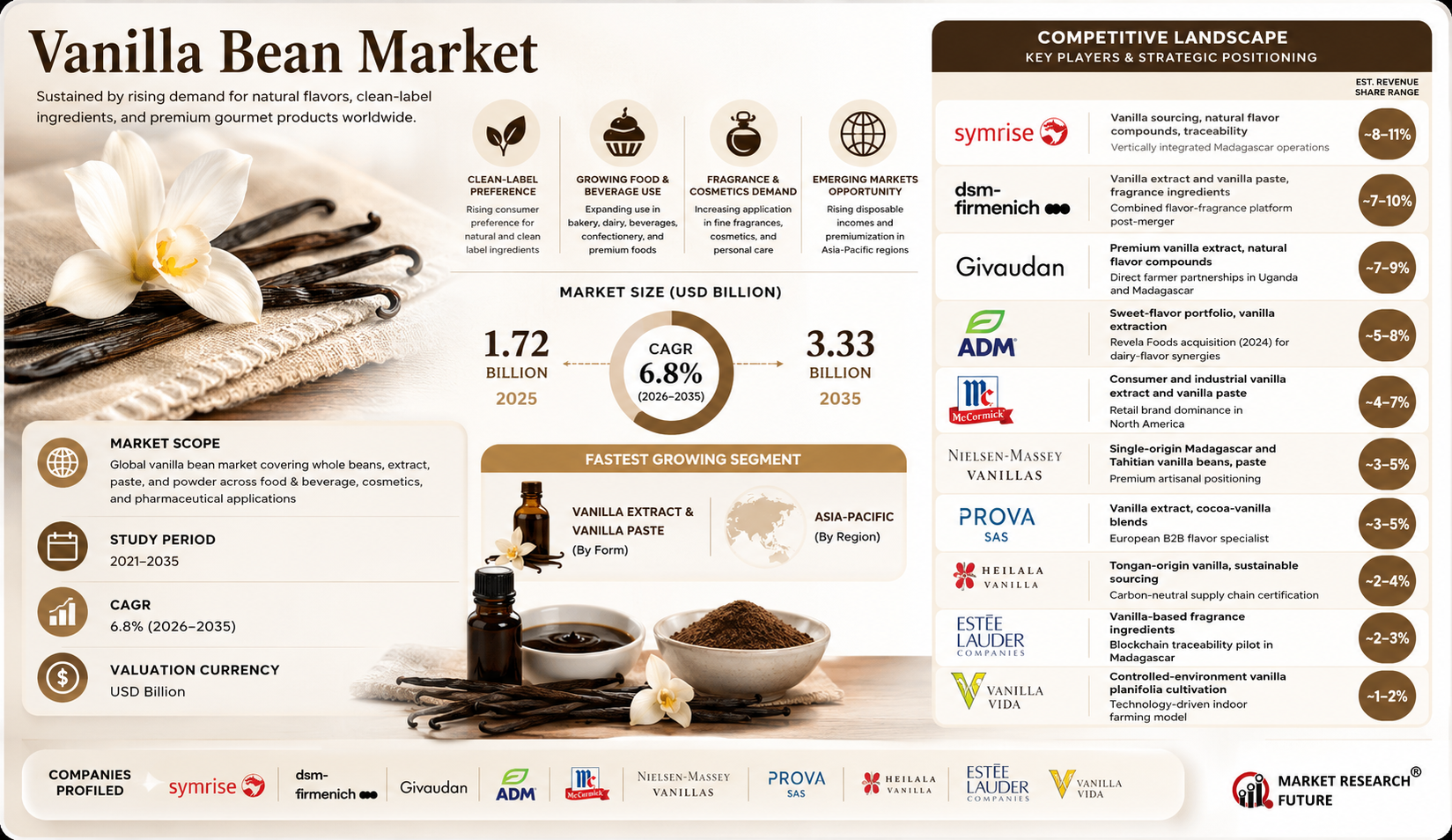
The global Vanilla Bean Market is entering a period of sustained expansion as food and beverage manufacturers, fragrance companies, cosmetics brands, and pharmaceutical formulators increasingly prioritize natural, recognizable, and traceable ingredients. The market is valued at USD 1.72 billion in 2025 and is projected to reach USD 3.33 billion by 2035, expanding at a 6.8% CAGR from 2026 to 2035. The market scope encompasses whole vanilla beans, vanilla extract, vanilla paste, and vanilla powder used across food and beverage, cosmetics, and pharmaceutical applications. Natural-origin positioning, premium product development, clean-label formulation, and the need for dependable sourcing are strengthening the commercial importance of vanilla across global value chains.
The competitive landscape combines large multinational flavor-and-fragrance companies, consumer brands, specialist vanilla suppliers, and emerging agricultural technology companies. Symrise leads with an estimated 8–11% revenue share range, supported by backward-integrated Madagascar operations and direct farmer relationships. dsm-firmenich and Givaudan follow with estimated ranges of 7–10% and 7–9%, respectively, while ADM, McCormick & Company, Nielson-Massey Vanillas, Prova, Heilala Vanilla, Estée Lauder Companies, and Vanilla Vida occupy specialized positions. Competition is increasingly centered on sourcing security, natural extraction capabilities, geographic diversification, certification, traceability, quality consistency, and the ability to translate vanilla into application-specific flavor systems. Symrise, for example, operates a vanilla extraction facility in Madagascar and has developed a backward-integrated sourcing model involving thousands of farmers.
Givaudan similarly emphasizes direct engagement with vanilla-producing communities. Its Madagascar sourcing model works with thousands of producers and focuses on traceability, agricultural practices, quality improvement, and long-term supply stability. The company states that Madagascar accounts for about 80% of global vanilla production, highlighting the strategic importance—and concentration risk—of the region.
Free Sample Copy – Access A Complimentary Copy of Our Report to Explore Its Content and Insights
https://www.marketresearchfuture.com/sample_request/38607
Key Market Drivers
One of the strongest growth factors is the shift toward natural and clean-label flavoring. Consumers increasingly associate recognizable ingredients with authenticity, quality, and premium positioning. Vanilla is particularly suited to this trend because it is widely understood by consumers and can be incorporated into products ranging from ice cream and bakery goods to beverages, dairy products, confectionery, sauces, nutritional products, and personal-care formulations. The move away from artificial flavor perceptions is encouraging manufacturers to increase the use of natural vanilla extracts and differentiated vanilla profiles.
Premiumization is another important driver. Madagascar Bourbon vanilla remains a benchmark for many premium formulations, while Tahitian, Tongan, Ugandan, Indonesian, and Indian origins allow manufacturers to create differentiated sensory profiles. Origin-specific beans can command greater value when they offer distinctive aroma characteristics, certification, traceability, or artisanal positioning. Specialist suppliers such as Nielson-Massey Vanillas benefit from this trend through single-origin beans and premium extracts, while Heilala Vanilla differentiates itself through Tongan-origin sourcing and sustainability credentials.
Market Segmentation by Form
The market can be divided into whole vanilla beans, vanilla extract, vanilla paste, and vanilla powder. Whole beans remain important for premium culinary applications, specialty foods, gourmet products, and formulations where visible vanilla seeds reinforce authenticity. However, whole beans require more handling and processing expertise, limiting their practicality for some large-scale manufacturers.
Vanilla extract and vanilla paste represent the fastest-growing form segment. Extract provides formulation flexibility and can be incorporated into beverages, dairy, bakery, confectionery, and processed foods at industrial scale. Vanilla paste occupies an attractive middle ground between whole beans and liquid extract because it can provide both concentrated flavor and visible vanilla particles. Its adoption is supported by premium desserts, bakery products, ice cream, specialty beverages, and artisanal food applications.
Vanilla powder serves applications requiring dry-format ingredients, including bakery mixes, nutritional products, dry beverages, confectionery systems, and certain pharmaceutical formulations. Its shelf-life, handling, and compatibility with dry formulations make it useful where liquid extracts are less convenient.
Market Segmentation by Application
Food and beverage represents the core application base because vanilla complements sweetness, dairy, cocoa, coffee, fruit, and caramel flavor systems. It is extensively used in ice cream, yogurt, bakery products, confectionery, chocolate, beverages, desserts, and ready-to-consume products. Product developers can also use vanilla to improve sensory perception in reduced-sugar formulations by adding aroma complexity.
The cosmetics and fragrance segment is expanding through demand for warm, sweet, gourmand, and natural fragrance profiles. Vanilla-derived ingredients can function as both recognizable fragrance notes and components of more complex accords. The ingredient’s association with comfort and indulgence makes it particularly relevant to fine fragrance, personal care, body care, and home fragrance.
Pharmaceutical applications represent a smaller but strategically relevant opportunity. Vanilla flavors and related taste technologies can help improve palatability in oral formulations, particularly where active pharmaceutical ingredients have unpleasant sensory characteristics. dsm-firmenich, for example, expanded its pharmaceutical taste-solutions portfolio in 2025 to include flavors, extracts, aromatic compounds, and taste-modulation technologies.
Regional Analysis
Asia-Pacific is projected to be the fastest-growing regional market. Population growth, expanding food-processing industries, urbanization, rising disposable incomes, and increasing consumption of premium foods and beverages are supporting demand. India, China, Indonesia, Japan, and Southeast Asian economies offer significant opportunities for vanilla-based applications.
North America remains an important mature market because of its extensive use of vanilla in packaged foods, dairy, bakery, beverages, and consumer extracts. McCormick & Company benefits from strong consumer recognition in this region, while specialist suppliers address premium and industrial requirements.
Europe has a strong position in premium foods, confectionery, bakery, fragrances, and natural ingredients. European manufacturers also face increasing expectations around responsible sourcing, certification, and supply-chain transparency, encouraging investment in traceable vanilla.
Madagascar remains the critical production center, creating both an advantage and a structural risk for the global market. Weather events, crop variability, farmer economics, logistics, and supply-chain concentration can influence availability and pricing. Consequently, major buyers are increasingly pursuing diversified sourcing strategies across Uganda, Indonesia, India, Papua New Guinea, and other origins. dsm-firmenich, for example, identifies multiple vanilla origins as part of its approach to supply security.
Competitive Landscape and Key Players
Symrise AG maintains a strong integrated position through vanilla sourcing, extraction, quality control, and farmer partnerships in Madagascar. Its local production model allows greater control over processing and traceability.
dsm-firmenich combines vanilla extracts and flavor expertise with a broader flavor-fragrance platform. Its multi-origin sourcing strategy and focus on natural, traceable vanilla strengthen its supply-security proposition.
Givaudan SA emphasizes premium natural vanilla, direct farmer engagement, traceability, and sustainable sourcing. Its Madagascar partnership network supports quality and supply continuity.
ADM has expanded its flavor capabilities through the acquisition of Revela Foods, adding dairy-flavor expertise that can complement applications where vanilla plays a central role.
McCormick & Company has strong retail and industrial positioning, particularly in North America. Nielson-Massey Vanillas focuses on premium single-origin beans, extracts, and paste. Prova SAS serves the European B2B flavor market, while Heilala Vanilla emphasizes Tongan-origin vanilla and sustainable sourcing.
Estée Lauder Companies represents the fragrance-side opportunity, while Vanilla Vida introduces a technology-driven alternative through controlled-environment cultivation and indoor curing.
Industry Developments
1. Controlled-environment vanilla production is advancing. Vanilla Vida has developed a controlled production model combining tissue culture, climate-controlled cultivation, indoor curing, data-driven quality management, and traceability. Its model includes operations and development across Israel, Uganda, and the Netherlands, illustrating how agricultural technology could complement conventional outdoor vanilla production and reduce exposure to weather-related variability.
2. Flavor companies are strengthening regional production and application capabilities. dsm-firmenich announced investments in India, including an expanded Kerala facility and a new Taste manufacturing plant in Gujarat designed for sweet and savory flavor production. Such investments demonstrate the broader industry movement toward regional manufacturing, localized innovation, and shorter supply chains in high-growth Asian markets.
Future Outlook
The Vanilla Bean Market is expected to move beyond simple volume expansion toward higher-value, traceable, diversified, and technologically managed supply chains. The projected increase from USD 1.72 billion in 2025 to USD 3.33 billion by 2035 reflects the growing role of vanilla across multiple industries rather than food applications alone.
Future competitive advantage will increasingly depend on the ability to secure reliable raw materials while maintaining consistent sensory quality and responsible sourcing. Companies with direct farmer relationships, diversified origins, advanced extraction technologies, certification capabilities, and stronger data visibility will be better positioned to manage supply volatility.
At the same time, premiumization and clean-label demand should support higher-value extracts and pastes, while controlled-environment cultivation could gradually introduce an additional source of supply. With Asia-Pacific identified as the fastest-growing region and vanilla extract and paste as the fastest-growing form segment, the market’s next phase is likely to be defined by application innovation, supply-chain resilience, and premium natural positioning.
Frequently Asked Questions
1. What is the projected size of the Vanilla Bean Market by 2035?
The Vanilla Bean Market is projected to reach USD 3.33 billion by 2035, compared with USD 1.72 billion in 2025, representing a 6.8% CAGR from 2026 to 2035.
2. Which segment is expected to grow fastest in the Vanilla Bean Market?
Vanilla extract and vanilla paste are identified as the fastest-growing form segment, while Asia-Pacific is expected to be the fastest-growing regional market.
Read Our Related Research Report
Vanilla Extract Market –
https://www.marketresearchfuture.com/reports/vanilla-extract-market-23816
Chocolate Cocoa Beans Lecithin Sugar Vanilla Market –
Vanilla Salt Market –
https://www.marketresearchfuture.com/reports/vanilla-salt-market-38608
Sagar Kadam
Market Research Future
+1 628-258-0071
email us here
Legal Disclaimer:
EIN Presswire provides this news content “as is” without warranty of any kind. We do not accept any responsibility or liability
for the accuracy, content, images, videos, licenses, completeness, legality, or reliability of the information contained in this
article. If you have any complaints or copyright issues related to this article, kindly contact the author above.

Media gallery